BOLLYGUM

Wombats

WOMBATS

wombat

‘Wombat lived in a small house under the shadow of a tall ghost gum.”

A.K.A. Vombatus ursinus,

The scientific name of the wombat comes partly from Latin – ‘ursinus’ means ‘bear’ – and partly from the word ‘vomat’ or ‘vombach’ from the Darug Aboriginal language.

Wombat in Bollygum is a Common Wombat. This species is also known as the Bare-Nosed Wombat, the Naked-Nosed Wombat, or the Island Wombat. The other wombat species are the Northern Hairy-Nosed Wombat and the Southern Hairy-Nosed Wombat.

The wombat is the animal most closely related to the koala. Like koalas, wombats are marsupials — this means that the mother has a pouch, and when she gives birth to her baby it lives in the pouch for a while, drinking her milk.

HABITATS
The different wombat species live in different areas. Common Wombats are usually found in Tasmania, and live mainly in forest-covered areas in south-eastern Australia.

APPEARANCE
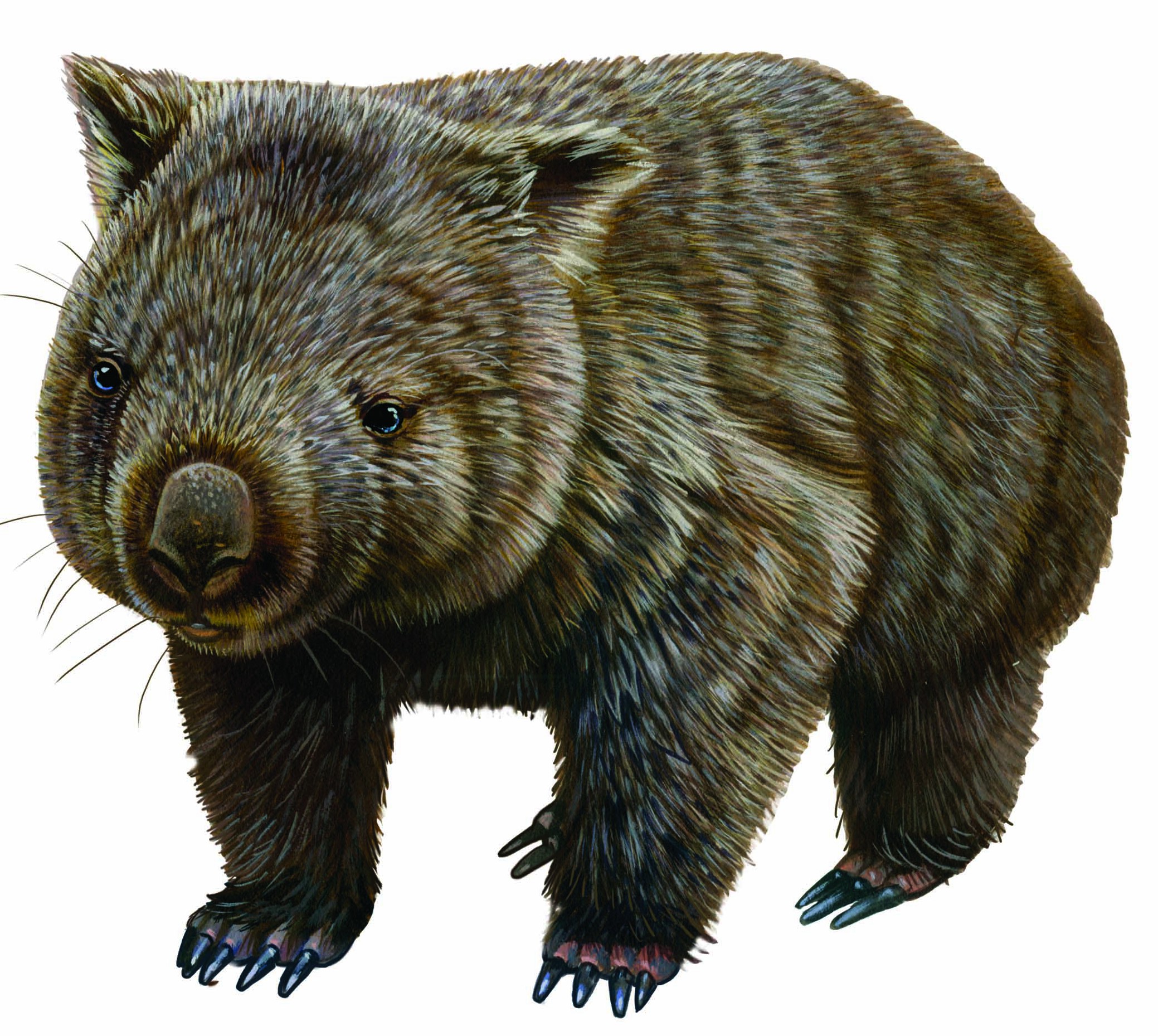
Common Wombats have large noses with no fur on them, small ears, and thick coarse fur like toothbrush bristles. Their fur can be sandy in colour, or brown or black.

Wombats grow up to about a metre long, and can weigh up to 40 kg. They have wide feet and claws and strong limbs. This makes it easy for them to make tunnels in the ground, or burrows, in which they live and also hide from their predators. They are the largest burrowing mammal, and the second biggest marsupial — only kangaroos are bigger.

Wombats have strong teeth, but because they are always chewing on tough grasses their teeth wear down. Fortunately, unlike most other species, their teeth grow continuously.

HABITS
Though wombats move slowly, they can speed up to about 40 km/h if in danger. When wombats feel threatened or angry, they growl or hiss.

When young wombats are lost, they communicate with their mothers by calling ‘huh, huh’ repeatedly. Their mothers reply with the same sounds.

Wombats throw sand over themselves to get clean, and they like to swim.

They are nocturnal animals. They come out of their burrows after sunset, when the air temperature cools. They usually go back to their burrows before sunrise, and stay there for most of the day.

DIET AND FEEDING HABITS
Wombats are herbivores — they are plant eaters. They like to eat roots and grasses, and sometimes tree bark also. If they can, they graze on crops, and are unpopular with farmers.

LIFE CYCLE
Wombats have one baby at a time, about once every two years. Pregnancy lasts for only a month before the baby is born. The baby is not fully developed at birth. It makes its way to the mother’s pouch, and stays there for six to ten months, growing and developing. Then it leaves the pouch, but stays with its mother for several months more before moving away to live independently. If danger threatens, it goes back into the pouch.

Wombats can live for five to ten years in the wild, but in captivity they can live as long as 30 years.

INTERESTING FACTS
A group of wombats is known as a ‘wisdom’.

To escape predators, wombats dive into one of their tunnels and block the entrance with their bottoms.

Wombat Day is on 22 October every year around the world.

Australia celebrates Hairy Nose Day on 11 May each year. On this day people ‘Wear Whiskers for Wildlife’ to draw attention to endangered species, and the Northern Hairy Nosed Wombat is used a symbol for all endangered species.

CONSERVATION NOTES
Dingoes, foxes and Tasmanian devils are the wombat’s natural predators. Wild dogs, which are an introduced species in Australia, are a great threat to weaker wombats, such as babies, injured animals and older animals. If a wombat is attacked by a single dog, it will usually be strong enough to survive, but it wouldn’t be able to keep up a fight against a pack of dogs.

Though it has predators, the Common Wombat is not considered an endangered species. But other types of wombats are more endangered. The Northern Hairy-Nosed Wombat is critically endangered, which means that this species may soon become extinct.

Though in most places in Australia wombats are protected by law, they are considered vermin in Victoria because they eat through fences and destroy crops.

REFERENCES

http://animals.nationalgeographic.com.au/animals/mammals/wombat/
http://australianmuseum.net.au/common-wombat
http://www.animalfactguide.com/animal-facts/common-wombat/
http://www.australianwildlife.net.au/pdf/wombat/AWS_Project_Wombat.pdf
Grzimek’s Encyclopedia of Mammals, 1990, vol.1, McGraw-Hill, New York
 

Orange Passionflowers

‘Wombat lived in a small house under the shadow of a tall ghost gum.

Perfumes from his garden of orange passionflowers and pink boronias filled the air. ‘

A.K.A. Blunt-leaved passionfruit Native passionfruit Red passionflower

Botantical Name:   Passiflora Aurantia (Passiflora comes from the Greek passio, meaning passion, which refers to the ‘passion of Christ’. If you look at Passionflower species found elsewhere, the choice of name is easier to understand as the busier, more intricate varieties obviously reminded someone of the crown of thorns. Aurantia comes from the Latin word aurantius, which means orange coloured.)

The Orange Passionflower found in Wombat’s garden is one of two native passionfruit plant species found in Australia. This plant occurs naturally from north-eastern New South Wales up to north Queensland, and grows on the edges of the rainforest or in sandy loam soils where nutrients are low.  It is common in Cairns.

THE STEM
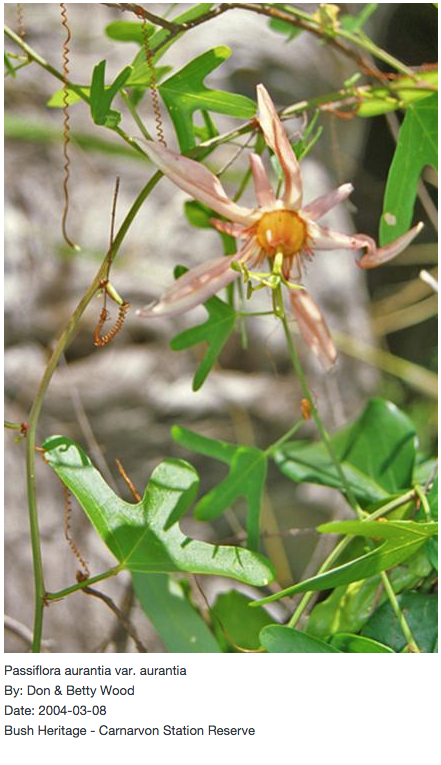
This plant is a climber. Its slender vine develops wonderful curly bits to help it grab on to other plants and branches. Its green leaves are flat, with three shallow rounded lobed ends, and grow up to 7cm long.

THE FLOWERS
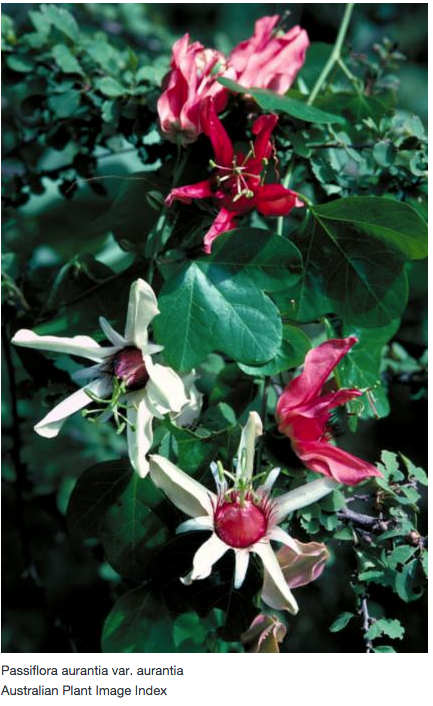
The flowers are about 4-8 cm in diameter. When they first start to open the petals are creamy in colour before gradually turning to pink and then orangey red over a 3-7 day period; the flowers never open completely before falling off. The flowers on one plant will all bloom at different times, so all the stages of the colour variations can be seen together when the plant is in flower. This plant flowers mainly in Winter and Spring, but does produce some flowers all year round.

THE FRUIT
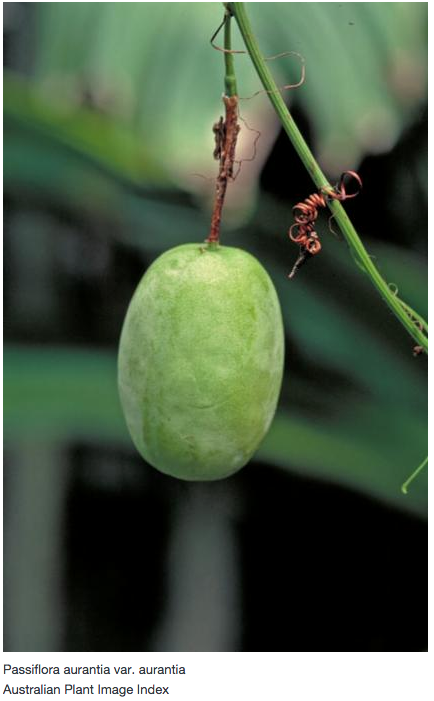
From the flower comes the green round fruit. The pulp is greyish in colour and filled with black seeds, each about 3mm x 2mm. The fruit turns slightly purple when ripe. The pulp is edible, but apparently it doesn’t taste very nice.

NATIVE FRIENDS
Butterflies, bees and some birds are attracted to the Passionflower. It provides good shelter for small birds and a bridge between the lower and higher plants.

GROW YOUR OWN
You can grow Orange Passionflowers in temperate climates. They do quite well both indoors and out, in full sun to semi-shade, but they don’t like the frost. Plant in fairly rich soils with average drainage. If you feed your Passionflower too much nitrogen, it won’t flower. You can plant it from seeds or from new growth cuttings. If growing from seeds, clean and dry the seeds from very overripe but unblemished fruits. The seeds and seedling are available from various on-line nurseries.

BAD RELATIVES
Though there are only two native Passionflower species in Australia, another four six species are found in this country. There are about 500 species globally. The non-native Australian species were introduced as ornamental flowers, and of course the common Passionfruit was introduced for its fruit. The bad species that cause problems are Corky Passionflower (Passiflora suberosa), Stinking Passionsfruit (Passiflora foetida) and White Passionflower (Passiflora subpeltata). Although we would not like to eat their fruit, some birds and animals do, and this has helped to spread these environmental weeds around, smothering native vegetation. The Australian native varieties are not invasive and don’t smother other plants.

A BIT OF HISTORY
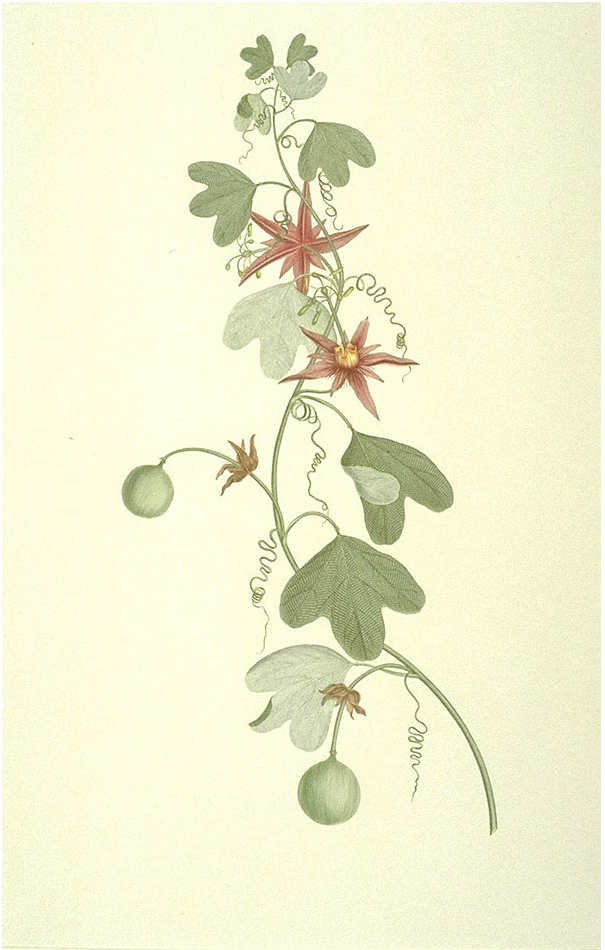
Passiflora Aurantia was one of the native Australian plants included in the Botanical illustrations from the voyage of HMS Endeavour (1776-1771). Artist Sydney Parkinson recorded most of the flora and fauna from this voyage. Sadly, he passed away at sea, but after the voyage other artists back in England embellished his sketches, under Sir Joseph Banks’ guidance and sponsorship, into wonderful engravings using Parkinson’s work as reference.

Passiflora Aurantia engraving
Caption on botanical Illustration from the Voyage of HMS Endeavour: “S. Parkinson del. 1770 / F.P. Nodder pinx.1780 / Plate 134 / D.MacKenzie sculps. / “PASSIFLORA AURANTIA… / Thirsty Sound, Australia / 29 May- 31 May 1770′ The specimen for this engraving came from Thirsty Sound on the Queensland coast. (about 500km north of Brisbane) Notes from the voyage:

‘May 29th 1770 ….   Anchored at Thirsty Sound [Town of 1770] and spent one night on the ship and landed searching for water but none found. Banks was enthused with all the botany and much impressed by the butterflies.’

It is interesting the butterflies are mentioned, as the Passionflower plant is a favourite food plant for the larvae of the Cruiser and Glasswing butterflies. Butterflies, bees and some birds are attracted to the Passionflower, and it’s a food plant for the larva of the Cruiser and other butterflies. CONSERVATION STATUS
Passiflora Aurantia still thrives, and is not considered to be at risk in the wild.

Screen Shot 2015-01-25 at 4.04.25 pm Passiflora Aurantia engraving Screen Shot 2015-01-25 at 4.03.26 pm

REFERENCES:
file:///Users/mac2/Downloads/Jan2007_LfWnewletter_lowres.pdf http://collectionsearch.nma.gov.au/object/165899 http://www.somemagneticislandplants.com.au/index.php/plants/739-passiflora-aurantia http://www.passionflow.co.uk/aurantia.htm http://www.saveourwaterwaysnow.com.au/01_cms/details_pop.asp?ID=272 http://anpsa.org.au/p-aur.html http://keys.trin.org.au/key-server/data/0e0f0504-0103-430d-8004-060d07080d04/media/Html/taxon/Passiflora_aurantia_var._aurantia.htm# http://www.brisbaneinsects.com/brisbane_nymphs/Glasswing.htm http://biocache.ala.org.au/occurrence/search?q=lsid%3Aurn%3Alsid%3Abiodiversity.org.au%3Aapni.taxon%3A296955#tab_recordImages

Welcome to Bollygum

bollygum title

Story and Paintings by Garry Fleming
First published by Weldon Kids 1995.


A tale of precious places and treasured friends.
Amongst our forests and woodlands there are untouched pockets where time stands still.
This is a story of one such place and the creatures that dwell in its valley.
This is the story of Bollygum. . .

Bollygum COVER

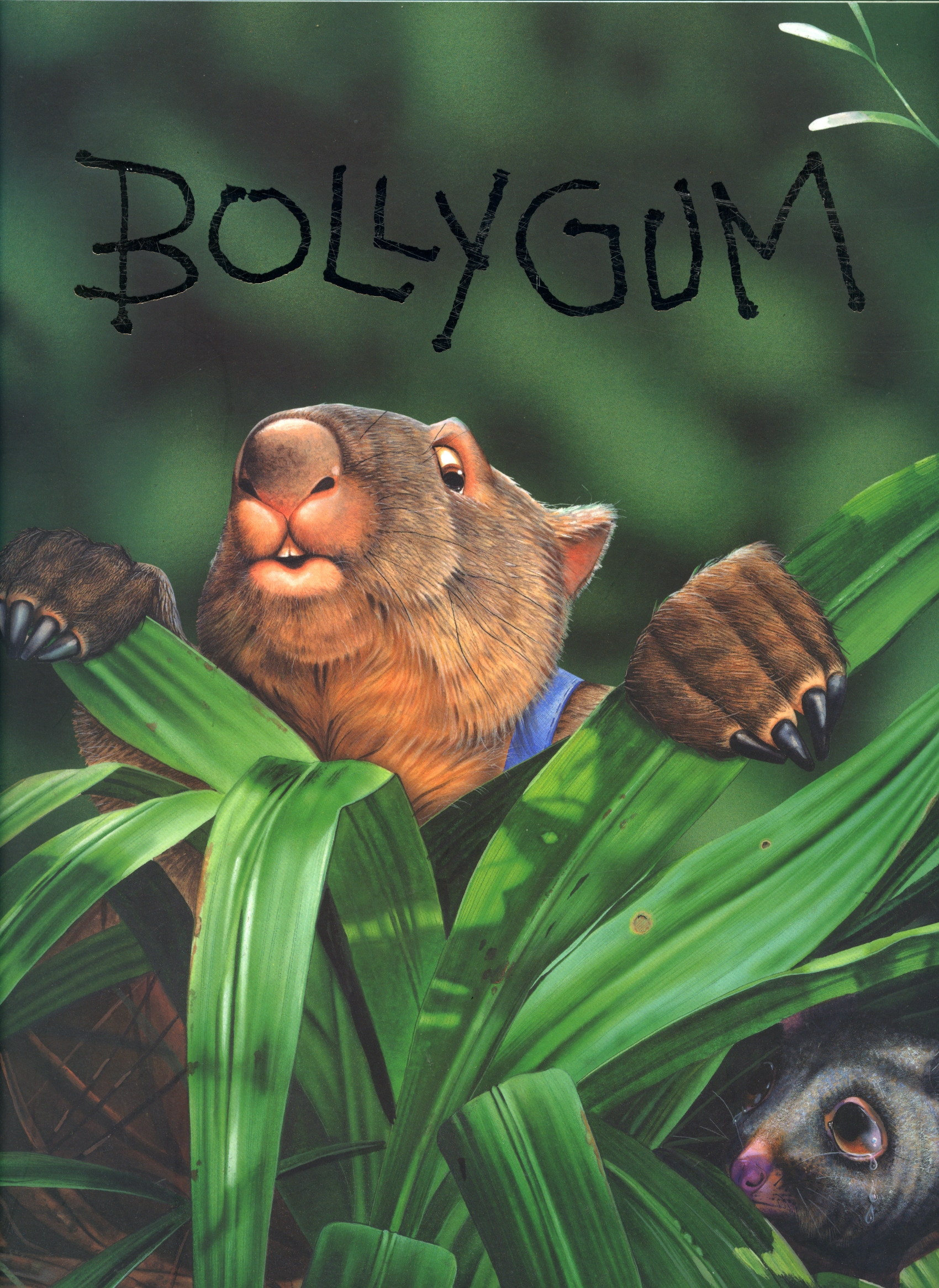
Front cover

Set in the Australian bush we meet wombat, a nervous content fellow that loves to fish everyday. One morning he is startled by the sound of someone crying, and discovers a little possum. Wombat soon learns that she is from the city and had been separated from her family, caught, and released into the bush.

Wombat decides they should visit the reclusive platypus for help, who suggests Wombat should call a town meeting. All the creatures of Bollygum meet at the big stump to discuss little possum’s dilemma.

The city is a mystery for the little creatures of Bollygum, no one knows how to get there.

Frogmouth, the wise wizard castes his spell to summons the cockatoo, who they believe might have seen the city in his travels. But it’s ring-tail possum that arrives with the information they need, a map that had belonged to his grandfather, and so the adventure begins. . .

Wombat’s compassion gives him and his friends the courage to venture beyond the land they know to take little possum back to her family. Each stage of their journey is a wonderful adventure through the bush with all sorts of mishaps and wonders.

Bollygum is a story of mateship and courage that has captured the hearts of Australian children since 1995. The story introduces the reader to some of Australia’s unique flora and fauna, the habitats in which they live, and the need for their protection.

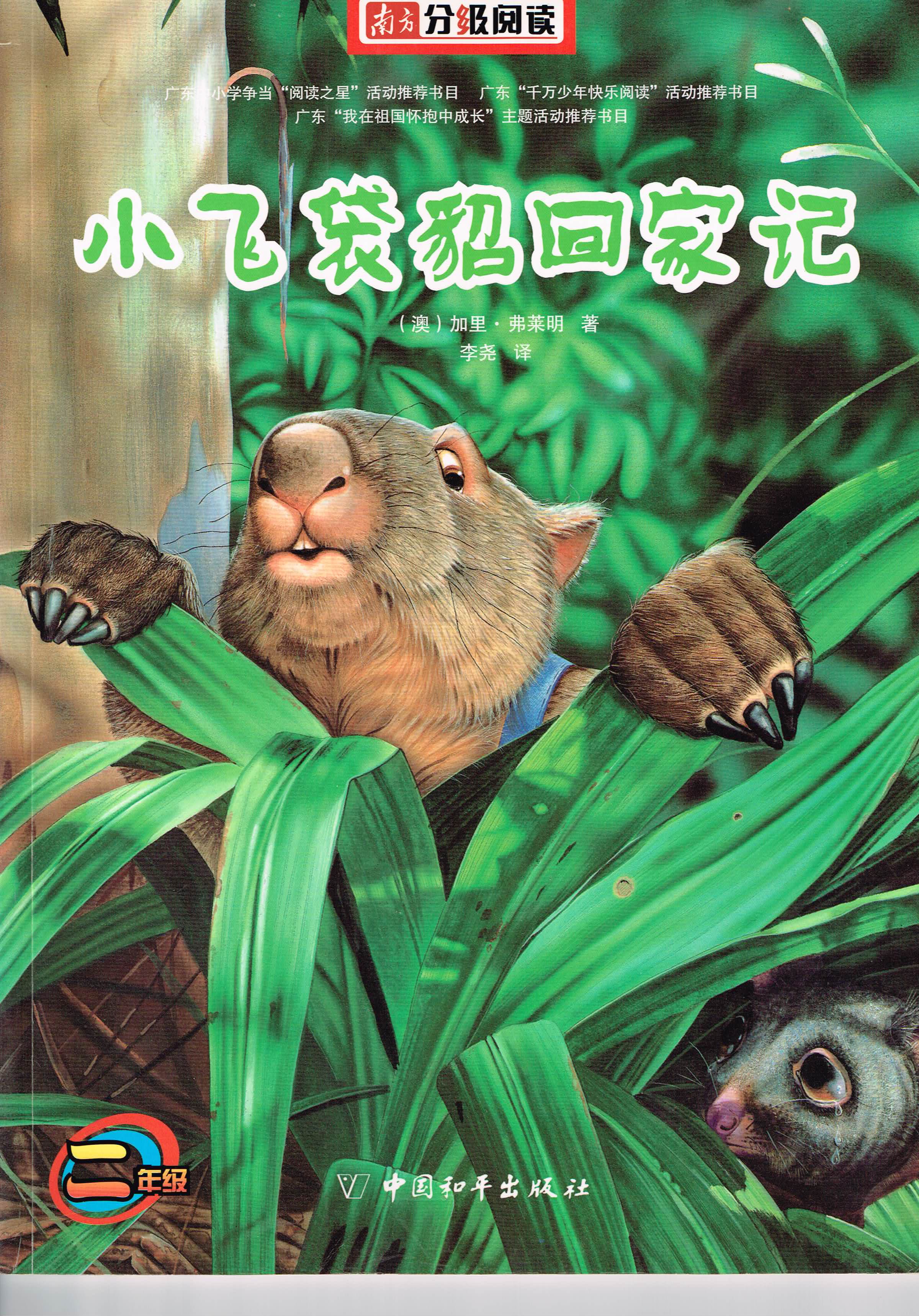
In 2009 the Chinese edition of Bollygum was launched with the highest print-run of an Australian story sold into the Chinese market.

In Kingslake Victoria there is a wonderful community park, Bollygum Park, based on the characters and places featured in the book.

In 2013 Bollygum was one of the classic Australian children’s books chosen by the Victorian Government, as a gift to Prince William and Kate, on the birth of Prince George.

To mark the 20th Anniversary of Bollygum Garry and I decided to put together this blog so we provide some background information about the book, and create more content and resources for parents, teachers, librarians, readers and other fans.

best regards
Leonie Weldon

Publisher.

Bollygum Chinese edition

bollygum Chinese edition

In 2009 Bollygum was chosen as part of the Chinese Government’s civil reading program for school children in Guangzhou. It’s a great program where the Government choose a collection of books for each age group, packs them in an economical pack for parents to buy the children. the Government subsidise the cost to make them affordable. The children have a years worth of books to read, and the parents know that good books have been selected by the educators. The reading program is supported by a ‘book club’ where the children can complete fun activities around the books, enter competitions and receive reward points for the most books read. During the launch we presented the top readers of the province with prizes.

This was the first time an Australian story has been selected for the reading program. Our partner was the China Peace Publishing House, a subsidiary of Song Qing Lin Foundation. The Nanfing Media Group, in Guangdong Province was the first educational distributor to take up the rights, with an initial print-run of 50,000 copies, the largest print-run of an Australian book into China.

We were honoured that the famous Chinese translator, Professor Li Yao translated the book into Chinese. He loves Australian stories and has translated such works as Patrick White’s Tree of Man, and Seven Little Australians, as well as various best selling Chinese titles into English for the western market. We received a lovely message from him saying how much enjoyed the story. Professor Li Yao holds the positions of Member of the Chinese Writers” Association, Member of the China-Australia Research Association and Professor of the Academic Training College for International Officials affiliated to the Ministry of Commerce.

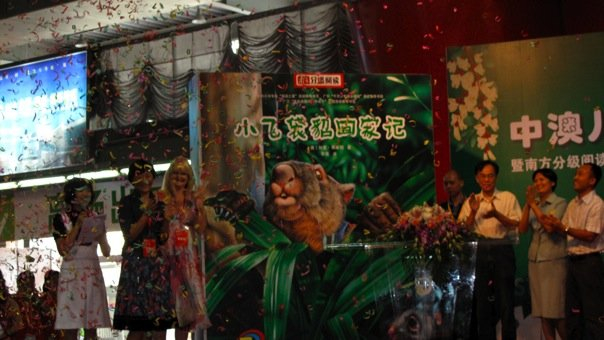
The Nanfang Reading Classification Research Centre held the launch at the Guangzhou Jinguang Exhibition Book Fair, reportedly the largest book fair in China. This was considered an important cultural exchange between Australia and China and was attended by the Cultural Counsellor from the Australian Embassy, Jill Collins.

“We need cultural exchanges. cultural intercourses create a win-win situation between China and Australia. We ought to share children’s books of high quality. We hope this cultural intercourse even is simply a good start of a very long journey in which more good Australian stories are introduced into China, and in turn a great variety of good Chinese children’s books are introduced into Australia, the children of both countries sharing the joy of reading” Jill Collins speech.

launch moment on state

BOLLYGUM Chinese Edition is launched

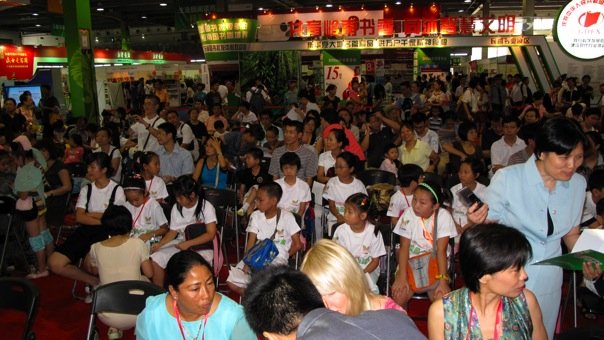
crowds

Crowds at the bookfair getting a seat to watch the Bollygum launch

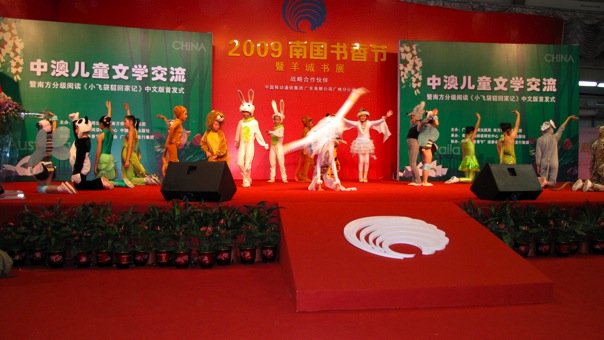
children dancing on stage

The school children performed a musical show based on the Bollygum story. They were all dressed in animal costumes. Unfortunately they couldn’t find costumes for the Australian animals but it didn’t matter it was such a wonderful show.

chinese peace pub

Xiao Li Yuan, Deputy Editor-in-Chief, China Peace Publishing House.

6389_160073984072_659649072_3498759_2642738_n

Jill Collins, the then Cultural Counsellor from the Australian Embassy talking with Yang Yi Kai, the deputy Director General of Guangdong Press and Publication Bureau, Chinese Government

leonie signing 2

Leonie Weldon signing copies of the books for the children.

the bollygum photo card leonie

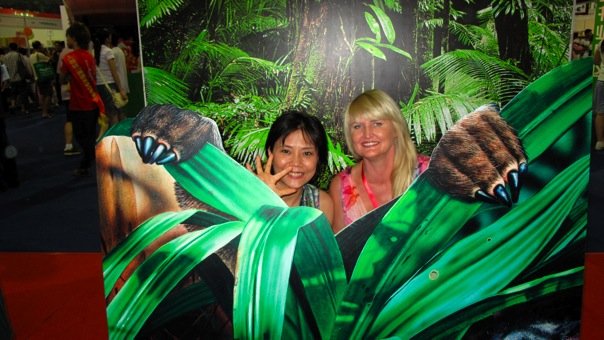
The display at the bookfair included a huge cutout of the cover, the crowds lined up to get their photos taken peeping over the fronds like wombat.